

One of the most stressful things about modern work is not simply having too much to do. It is having too many things that all seem important at the same time. A manager needs an update. A client is waiting. A coworker asks for help. Your inbox keeps growing. A deadline is moving closer. Then someone marks a message urgent, and suddenly your whole day feels like a race you did not agree to run.
When everything feels important, it becomes harder to think clearly. You may jump from task to task, answer whoever is loudest, or work on the thing that feels most uncomfortable to ignore. You may end the day exhausted, but still unsure whether you made real progress on the work that mattered most.
This is the trap of urgency culture. It makes every task feel like it deserves immediate attention. But if everything is treated as equally important, you lose the ability to choose. Prioritization is not about doing more. It is about deciding what deserves your best attention now, what can wait, what can be reduced, and what should not be yours at all.
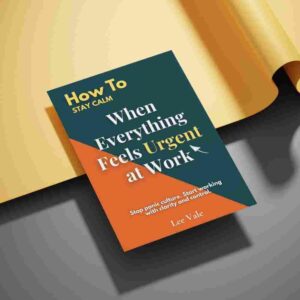
Manuscript 4 focuses on urgency culture, panic at work, focus, prioritization, calm communication, and building systems that help you work with clarity instead of constant reaction.
Why everything starts to look equally important
When work is busy, the brain often responds to pressure instead of value. The task with the loudest request feels important. The message with the strongest tone feels important. The person who follows up repeatedly feels important. But emotional volume is not the same as actual priority.
A task may feel important because someone is anxious. It may feel important because it has been ignored for too long. It may feel important because the deadline is close, even if the outcome itself is low value. It may feel important because you do not want someone to be upset with you.
This is why prioritization requires a pause. Without a pause, your nervous system will choose for you. It will push you toward the thing that creates the most immediate discomfort, not necessarily the thing that creates the most meaningful result.
Separate urgency from impact
The first step is to ask what will actually happen if the task waits. Not what someone fears might happen. Not what the tone of the message suggests. What will actually happen?
A task is urgent when delay creates real consequences. It may affect a customer, a legal deadline, a financial issue, a critical deliverable, or a team blocker. A task is important when it moves meaningful work forward, even if it is not screaming for attention.
Some tasks are both urgent and important. Handle those quickly. Some are urgent but not very important. Schedule or delegate them if possible. Some are important but not urgent. Protect time for those because they often create the most long-term value. Some are neither. Those are the tasks that quietly steal your day if you let them.
The goal is not to ignore urgency. The goal is to stop confusing urgency with importance.
Use a simple priority filter
When your list feels overwhelming, do not try to solve the whole day at once. Use a short filter to identify the next best move.
Ask yourself:
- What has the biggest consequence if it does not get done today?
- What directly supports my main responsibility or goal?
- What is blocking someone else from moving forward?
- What can be delayed without serious impact?
- What is loud, but not actually valuable?
These questions help you move from panic to judgment. You are not choosing based only on emotion. You are choosing based on consequence, responsibility, and value.
If you are still stuck, pick one “must move forward” task. It does not have to be completed today. It just needs meaningful progress. This keeps important work from disappearing under urgent noise.
Make trade-offs visible
One reason people become overloaded is that they silently accept competing priorities. They try to do everything without showing what has to move. This creates hidden stress and unrealistic expectations.
When two priorities compete, say so clearly. For example: “I can finish the client update today, or I can prepare the meeting summary by 3 PM. I cannot complete both at the same quality in that window. Which should come first?”
This kind of communication is not complaining. It is managing reality. It gives your manager or team the information they need to make a better decision.
Trade-off language is especially important in urgency-heavy workplaces. Without it, people may assume your time expands every time a new task appears. When you make trade-offs visible, you teach others that time, attention, and quality are connected.
Stop using your inbox as your priority list
Your inbox is not a strategy. Neither is your chat window. If you let incoming messages decide your day, you will naturally prioritize the newest, loudest, or easiest request. That may feel productive, but it often pulls you away from the work that actually matters.
Create a separate priority list for the day. Keep it short. Choose two or three outcomes that matter most. Then check incoming requests against that list.
If a new request supports one of those outcomes, consider moving it up. If it does not, schedule it, delegate it, or respond with a realistic timeline. This helps you stay responsive without becoming controlled by every incoming signal.
You can still check messages. You just should not let messages become the boss of your attention.
Protect important but quiet work
Important work often does not scream. Planning, writing, analysis, process improvement, preparation, relationship-building, and thoughtful review can be easy to postpone because they rarely arrive with dramatic urgency. But this is often the work that prevents future emergencies.
If you keep sacrificing important work for urgent noise, your future workload gets worse. Problems repeat. Decisions stay unclear. Mistakes increase. You end up living in the same urgency you were trying to escape.
Protect quiet work by putting it on your calendar. Treat it like a meeting with real consequences. Even one focused hour can make a difference if it moves a meaningful project forward.
Prioritization is not only about today’s pressure. It is also about preventing tomorrow’s panic.
Final thought
When everything at work feels important, the answer is not to move faster at everything. That only creates more stress and more mistakes. The answer is to slow down enough to choose.
Separate urgency from impact. Use a priority filter. Make trade-offs visible. Stop letting your inbox choose your day. Protect important work before it becomes another emergency.
You will always have more requests than time. That is why prioritization is not a luxury. It is a survival skill. The calmer and clearer you become about what matters most, the less your workday will be controlled by panic, pressure, and whoever happens to ask the loudest.
Related Articles:
How to Stop Treating Every Work Request Like an Emergency
How to Stay Calm When Your Workplace Runs on Panic
Why Saying Yes Too Often Can Make You Less Reliable at Work