

Some workplaces do not just have busy days. They have a panic rhythm. Every message feels urgent. Every deadline sounds like a crisis. Every small delay becomes a dramatic conversation. People rush, react, interrupt, escalate, and call it productivity.
At first, this kind of environment can make you feel important. There is a certain energy in being needed right away. You answer quickly. You jump into problems. You help put out fires. But over time, the constant pressure starts to change how you work. You become more reactive. Your focus gets weaker. Your body stays tense. You finish the day exhausted, even if the most important work barely moved forward.
A workplace that runs on panic can make calm people feel irresponsible. If everyone else is rushing, pausing can feel wrong. But calm is not laziness. Calm is how you make better decisions when the environment is trying to pull you into urgency culture.
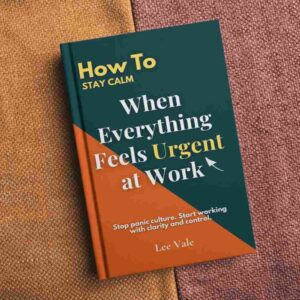
Manuscript 4 focuses on urgency culture, panic at work, focus, prioritization, managing up, calm communication, and long-term resilience. Its core idea is simple but powerful: not everything that feels urgent deserves the same reaction.
Why panic becomes normal at work
Panic becomes normal when teams confuse motion with progress. People answer fast, schedule more meetings, send more messages, and treat responsiveness as proof of commitment. The workplace starts rewarding visible activity more than thoughtful work.
This creates a cycle. Someone escalates a small problem. Others react quickly because they do not want to look slow. Leaders praise the quick response. The next time a similar issue appears, people escalate even faster. Before long, the team stops asking whether something is truly urgent. The tone alone becomes enough to trigger action.
The result is a workplace where everyone looks busy, but fewer people are thinking clearly. Decisions get rushed. Communication becomes messy. Priorities change too often. Important but quiet work gets pushed aside because it does not scream for attention.
Notice the difference between urgency and importance
A task can feel urgent without being important. A message can be loud without being meaningful. A request can demand attention without deserving immediate action.
This distinction matters because panic culture trains you to respond to emotional volume. The louder the request sounds, the faster you move. But important work is not always loud. Sometimes it is the focused report, the careful review, the strategic decision, or the quiet follow-up that prevents future problems.
Before reacting, ask: what is actually at stake? Will something serious happen if this waits one hour? Is there a deadline that cannot move? Is there a customer, legal, safety, or financial risk? Or is this mostly pressure caused by poor planning, anxiety, or unclear ownership?
These questions help you respond to reality instead of tone.
Use a pause as a professional tool
In a panic-driven workplace, pausing may feel uncomfortable. But a pause is not avoidance. It is a reset that helps you choose the right response.
A useful pause can be as short as 30 seconds. Stop typing. Breathe. Read the request again. Ask what the next useful action is. That brief moment can prevent you from sending a rushed message, accepting an unrealistic deadline, or abandoning important work unnecessarily.
You can also use a calm holding response. For example: “I see this. I’ll review and confirm next steps by 2 PM.” This tells the other person you are not ignoring them, but it also protects you from instantly reacting before you understand the situation.
The pause gives your brain time to move from alarm to judgment. That is where better work happens.
Communicate calm without sounding dismissive
When others are panicking, your calm can be misread if you are not careful. People may think you do not understand the pressure or that you are not taking the issue seriously. That is why calm communication should be specific, not vague.
Instead of saying, “Don’t worry,” say, “I understand this is time-sensitive. I’ll check the file now and send an update by 11 AM.”
Instead of saying, “This is not urgent,” say, “I want to confirm the impact before we interrupt the current deadline.”
Instead of saying, “Everyone needs to calm down,” say, “Let’s identify the next action, the owner, and the real deadline.”
Calm communication does not deny the pressure. It organizes it.
Protect your focus from constant interruption
Panic culture destroys focus because it trains everyone to be constantly reachable. You may try to work deeply, but messages, calls, meetings, and sudden requests keep slicing your attention into pieces.
To protect focus, you need visible structure. Block time for important work. Use status messages when you are unavailable. Batch responses when possible. Clarify what counts as a true emergency. If you are in a role where people need access to you, create predictable windows instead of being open to interruption all day.
This is not about being difficult. It is about preserving the kind of attention that produces quality work. If every interruption gets immediate access to your mind, your most important tasks will always compete with the loudest request.
Do not absorb everyone else’s panic
One of the hardest parts of a panic-driven workplace is emotional contagion. A coworker rushes into a conversation stressed, and suddenly your body reacts too. A manager sends a sharp message, and your attention narrows. Someone else’s urgency becomes your internal alarm.
You can acknowledge pressure without absorbing it. Try saying, “I hear this is stressful. What outcome do we need first?” This validates the situation while moving the conversation toward action.
You can also set a boundary around emotional urgency. If someone brings heat instead of facts, redirect gently: “Let’s focus on what needs to happen next.” That sentence keeps you from becoming a container for someone else’s panic.
Build small calm systems
Calm is easier when it is supported by systems. Without systems, every request becomes a fresh decision. With systems, you have a repeatable way to respond.
Useful calm systems include a daily priority list, protected focus blocks, a triage rule for urgent requests, and a short end-of-day reset. You can also use a simple classification system: critical, important, or not critical. Critical needs immediate action. Important needs attention but can be scheduled. Not critical can be delayed, delegated, or declined.
These systems do not remove pressure completely. But they reduce the number of times pressure gets to decide for you.
Final thought
A workplace that runs on panic can make calm feel unnatural. But panic is not proof that work matters. Sometimes it is proof that the system lacks clarity.
You do not need to match everyone else’s urgency to show commitment. You can be responsive without being reactive. You can care about outcomes without letting every message hijack your nervous system. You can move quickly when it truly matters and still protect your ability to think.
Calm is not the opposite of action. Calm is what makes the right action possible.
Related Articles:
How to Stop Treating Every Work Request Like an Emergency
How to Identify the Co-Workers Who Drain Your Energy
How to Work With a Boss Who Thinks Meetings Mean Productivity